Achieving 2026 Goals: Top Personal Growth Frameworks for US Professionals

Effectively achieving 2026 goals requires U.S. professionals to adopt robust personal growth frameworks that integrate strategic planning, continuous learning, and well-being for sustained success in evolving careers.
As U.S. professionals look towards the future, specifically to 2026, the landscape of work and personal development continues to evolve rapidly. Successfully navigating this dynamic environment and truly achieving your 2026 goals demands more than just ambition; it requires a structured approach to personal growth. This article will delve into three prominent personal growth frameworks, comparing their core tenets and evaluating their suitability for the modern American professional aiming for significant achievements in the coming years.
the evolving landscape of professional growth in 2026
The professional world in 2026 is marked by unprecedented change, driven by technological advancements, shifts in global markets, and an increased emphasis on work-life integration. Professionals are no longer simply seeking career advancement; they are pursuing holistic development that encompasses mental well-being, continuous skill acquisition, and a sense of purpose. This complex environment necessitates adaptable and effective strategies for personal growth.
Traditional approaches to goal setting often fall short in this rapidly changing context. The rigid, linear models of the past struggle to accommodate unforeseen disruptions or emergent opportunities. Therefore, a more fluid, yet structured, methodology is essential for sustained progress and resilience.
the demand for adaptability and resilience
In today’s fast-paced professional world, the ability to adapt to new technologies, market trends, and organizational structures is paramount. Resilience, the capacity to recover quickly from difficulties, is equally crucial. Personal growth frameworks must cultivate these qualities.
- Technological Proficiency: Embracing AI, automation, and data analytics.
- Market Responsiveness: Understanding and anticipating industry shifts.
- Emotional Intelligence: Navigating complex interpersonal dynamics.
holistic well-being as a cornerstone
The conversation around professional success has broadened to include mental and physical health. Burnout is a significant concern, making well-being a non-negotiable component of any effective growth strategy. Frameworks that ignore this aspect are inherently incomplete.
The modern professional understands that peak performance is unsustainable without adequate self-care and a balanced life. This integration of personal well-being into professional objectives is a defining characteristic of successful goal achievement in 2026. Ultimately, the frameworks discussed here aim to provide not just a path to success, but a sustainable one.
framework 1: the agile personal development (APD) model
The Agile Personal Development (APD) model, inspired by software development methodologies, is gaining significant traction among U.S. professionals. It emphasizes iterative progress, continuous feedback, and flexibility, making it highly suitable for those operating in dynamic work environments. Instead of rigid, long-term plans, APD encourages professionals to set short-term, adaptable goals and regularly review their progress.
This framework thrives on experimentation and learning from both successes and failures. It recognizes that the path to achieving ambitious goals is rarely linear and often requires adjustments based on new information or changing circumstances. APD promotes a mindset of continuous improvement, where each iteration brings new insights and refined strategies.
core principles of APD
At its heart, APD embraces several key principles that distinguish it from more traditional approaches. These principles foster a proactive and responsive stance towards personal and professional growth.
- Iterative Cycles: Breaking down large goals into smaller, manageable sprints (e.g., 2-4 weeks).
- Regular Retrospectives: Reflecting on what worked, what didn’t, and how to improve.
- Adaptability: Being open to changing direction based on feedback and new data.
- Prioritization: Focusing on the most impactful tasks first.
benefits for U.S. professionals
For U.S. professionals, particularly those in tech, marketing, or creative industries, APD offers a compelling alternative to static goal-setting. It allows for rapid adjustments to market demands and personal priorities, reducing the risk of investing significant effort in outdated objectives.
The emphasis on continuous learning and self-correction aligns perfectly with the need for lifelong skill development in a competitive job market. Moreover, the structured yet flexible nature of APD can help mitigate burnout by encouraging sustainable work rhythms and celebrating small victories along the way. This framework helps professionals stay engaged and motivated, even when faced with complex challenges.
framework 2: the integrated well-being and performance (iwp) approach
The Integrated Well-being and Performance (IWP) approach is designed for professionals who recognize the inseparable link between personal well-being and sustained high performance. This framework moves beyond merely setting professional goals to intentionally integrate practices that foster mental clarity, physical health, and emotional resilience. It argues that true productivity and long-term success are impossible without a solid foundation of holistic well-being.
IWP encourages a balanced perspective, where career aspirations are viewed alongside personal fulfillment and health. It’s not about sacrificing one for the other, but rather about creating synergy between various life domains. This framework is particularly relevant in 2026, as companies increasingly prioritize employee well-being and embrace flexible work models.
pillars of IWP
The IWP approach rests on several interconnected pillars, each contributing to a more balanced and effective professional life. Neglecting any one pillar can compromise overall performance and well-being.
- Mindfulness and Mental Clarity: Practices like meditation, journaling, and digital detoxes.
- Physical Health: Consistent exercise, nutritious diet, and adequate sleep.
- Emotional Regulation: Developing self-awareness and healthy coping mechanisms.
- Purpose and Connection: Aligning work with personal values and fostering strong relationships.
practical application for busy professionals
Implementing IWP doesn’t require extensive time commitments; rather, it’s about integrating small, consistent practices into daily routines. For example, a busy professional might dedicate 15 minutes each morning to mindfulness or schedule short walking breaks throughout the workday. The key is consistency and intentionality.
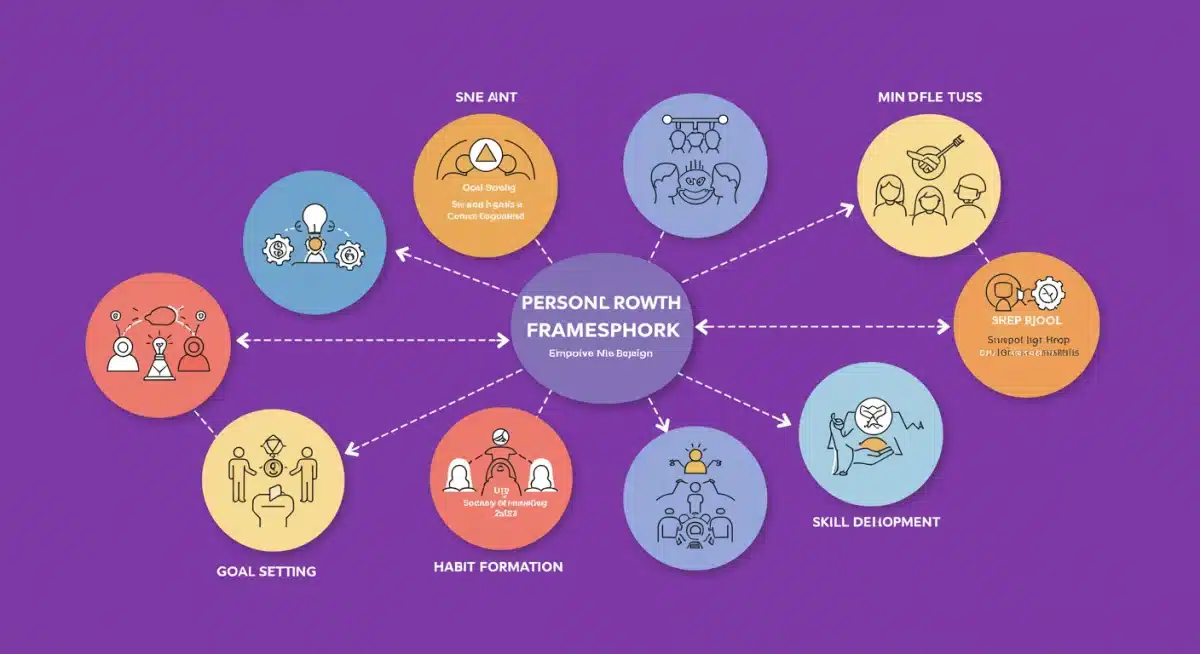
This framework also encourages professionals to advocate for their well-being within their organizations, promoting a culture that supports flexible work arrangements and mental health resources. By prioritizing well-being, professionals can enhance their cognitive function, creativity, and overall job satisfaction, ultimately leading to greater success in achieving your 2026 goals.
framework 3: the skills-based mastery (SBM) model
The Skills-Based Mastery (SBM) model is a highly practical framework focused on identifying, acquiring, and mastering specific skills that are critical for professional advancement in 2026. This approach is particularly appealing to U.S. professionals in rapidly evolving fields where new competencies are constantly emerging. SBM emphasizes a systematic and deliberate effort to build a robust skill set that directly contributes to career objectives.
Unlike broader personal growth models, SBM narrows its focus to tangible, measurable skills. It’s about becoming exceptionally good at what you do, or at what you need to do to reach your next professional milestone. This model is ideal for those who thrive on structured learning and clear progression paths.
identifying critical skills for 2026
The first step in the SBM model is a rigorous assessment of current skills versus future demands. This often involves analyzing industry trends, job market data, and personal career aspirations to pinpoint the most valuable competencies.
- Future-Proofing Skills: AI literacy, data interpretation, cybersecurity fundamentals.
- Soft Skills for Collaboration: Advanced communication, negotiation, cross-cultural competence.
- Leadership Capabilities: Strategic thinking, team empowerment, change management.
strategies for skill acquisition and mastery
Once critical skills are identified, SBM outlines clear strategies for their acquisition and mastery. This can range from formal education and certifications to hands-on projects and mentorship. The emphasis is on active learning and practical application.
The SBM model encourages professionals to create a personalized learning roadmap, allocating dedicated time and resources to skill development. It also stresses the importance of deliberate practice, where skills are honed through focused repetition and constructive feedback. This systematic approach ensures that learning translates into measurable improvements in performance and capabilities, directly supporting the ambitious task of achieving your 2026 goals.
comparing the frameworks: which one is right for you?
Choosing the right personal growth framework depends largely on your individual goals, professional context, and preferred learning style. Each of the three frameworks—Agile Personal Development (APD), Integrated Well-being and Performance (IWP), and Skills-Based Mastery (SBM)—offers distinct advantages for U.S. professionals.
APD is excellent for those in fast-changing environments who value flexibility and iterative progress. It’s about adapting quickly and learning on the fly. IWP, on the other hand, prioritizes a holistic approach, recognizing that sustainable success is built on a foundation of mental and physical health. SBM is for the goal-oriented professional who wants to systematically acquire and master specific, high-value skills.
consider your professional environment
Your industry and role play a significant part in determining the most effective framework. A tech entrepreneur might lean towards APD, while a healthcare professional might find IWP more suitable for managing demanding schedules and preventing burnout.
- High-Volatility Industries: APD’s adaptability is a major asset.
- Service-Oriented Roles: IWP’s focus on resilience and empathy can be transformative.
- Specialized Technical Fields: SBM provides a clear path for continuous expertise development.
aligning with personal values and learning style
Ultimately, the most effective framework is one that resonates with your personal values and how you naturally approach learning and development. If you thrive on structured learning and clear objectives, SBM might be your best fit. If you prefer a more organic, experimental path, APD could be more appealing. If overall balance is your priority, IWP stands out.
Many professionals may even find success by blending elements from these frameworks. For instance, an APD practitioner could integrate IWP principles for well-being during their sprints, or an SBM enthusiast might use APD’s iterative cycles for skill acquisition. The key is to customize the approach to best support achieving your 2026 goals in a way that is both effective and sustainable.
integrating frameworks for maximum impact
While each framework offers a powerful standalone approach to personal growth, their true potential often lies in thoughtful integration. For U.S. professionals aiming for comprehensive development and robust goal achievement by 2026, combining elements from APD, IWP, and SBM can create a highly customized and effective strategy. This blended approach acknowledges the multifaceted nature of professional success, which requires both adaptability, well-being, and specialized expertise.
Consider a scenario where a professional in a rapidly evolving tech sector needs to master new AI tools (SBM), while also managing a demanding workload and preventing burnout (IWP), all within a project that requires constant iteration and adjustment (APD). A rigid adherence to just one framework might leave gaps. By strategically combining them, individuals can build a more resilient and dynamic growth plan.
synergistic application examples
The beauty of integrating these frameworks is their complementary nature. They address different, yet equally vital, aspects of professional life. Here are a few ways they can work together:
- APD + SBM: Use APD’s short sprints and retrospectives to systematically acquire and practice new skills identified through SBM. Each sprint could focus on mastering a specific sub-skill.
- IWP + APD: Integrate well-being practices (IWP) into your daily or weekly APD sprints, ensuring that self-care is a non-negotiable part of your iterative development cycles. This prevents burnout while maintaining agility.
- SBM + IWP: As you pursue skill mastery (SBM), use IWP principles to manage the stress of learning and maintain focus. Ensure that deep work sessions are balanced with restorative practices.
creating your personalized growth roadmap
The ultimate goal is to craft a personal growth roadmap that is uniquely yours. Start by identifying your primary challenges and aspirations for 2026. Are you struggling with work-life balance? Is a specific skill bottlenecking your career? Or do you need a more flexible way to manage evolving objectives?
Once you understand your core needs, you can selectively draw from the strengths of each framework. This bespoke approach ensures that your efforts are targeted, sustainable, and maximally effective in achieving your 2026 goals. Regular review and adaptation are crucial, mirroring the agile mindset, to keep your integrated framework relevant and impactful.
setting yourself up for success in 2026 and beyond
As we look towards 2026, the commitment to personal growth is not merely an option but a strategic imperative for U.S. professionals. The frameworks discussed—Agile Personal Development, Integrated Well-being and Performance, and Skills-Based Mastery—provide robust pathways for achieving ambitious goals. However, the true measure of success lies in their consistent and thoughtful application.
Beyond simply choosing a framework, setting yourself up for long-term success involves cultivating a growth mindset, embracing continuous learning, and building a supportive ecosystem around your development journey. This includes leveraging digital tools, seeking mentorship, and fostering a community of like-minded individuals.
the role of continuous learning and adaptation
The professional landscape will continue its rapid evolution beyond 2026. Therefore, the ability to continuously learn, unlearn, and relearn will remain a critical skill. No single framework is a static solution; rather, they are dynamic tools that must be adapted and refined over time.
- Stay informed: Regularly consume industry news, research, and thought leadership.
- Seek feedback: Actively solicit constructive criticism from peers and mentors.
- Experiment: Be willing to try new approaches and discard those that don’t work.
building a supportive ecosystem
Personal growth is rarely a solitary endeavor. Surrounding yourself with a supportive network can significantly enhance your chances of success. This includes colleagues, mentors, coaches, and even digital communities focused on professional development.
Leveraging technology, such as habit-tracking apps, project management tools, and online learning platforms, can also amplify your efforts. By strategically applying these advanced personal growth frameworks and fostering a supportive environment, U.S. professionals can not only achieve their 2026 goals but also build a foundation for sustained excellence and fulfillment in their careers for years to come.
| Framework | Key Focus |
|---|---|
| Agile Personal Development (APD) | Iterative progress, flexibility, continuous feedback, ideal for dynamic environments. |
| Integrated Well-being and Performance (IWP) | Holistic integration of mental, physical, and emotional health with professional goals. |
| Skills-Based Mastery (SBM) | Systematic acquisition and mastery of specific, high-value professional skills. |
frequently asked questions about 2026 personal growth
Adaptability is arguably the most critical factor. The rapid pace of technological change and evolving market demands necessitates a flexible mindset and the ability to continuously learn and adjust strategies for achieving your 2026 goals.
Absolutely. Combining elements from Agile Personal Development, Integrated Well-being and Performance, and Skills-Based Mastery can create a highly personalized and robust strategy. Many professionals find success by blending these approaches to suit their unique needs and circumstances.
Progress measurement varies by framework. APD uses short-term sprint reviews and retrospectives. IWP focuses on well-being metrics and sustained performance. SBM tracks skill acquisition through certifications, project completion, or performance evaluations. Define clear, measurable outcomes for each goal.
While designed with U.S. professionals in mind, these frameworks are highly adaptable. Entrepreneurs, freelancers, and even individuals focusing on personal projects can apply these principles to achieve their objectives, leveraging the structure and flexibility offered.
Start small. Don’t try to implement everything at once. Pick one or two key principles from a framework that resonate most with your immediate needs. Gradually integrate more elements as you build momentum and confidence, making the process sustainable.
conclusion
The journey towards achieving your 2026 goals as a U.S. professional is a strategic one, requiring more than just ambition. By understanding and selectively applying frameworks like Agile Personal Development, Integrated Well-being and Performance, and Skills-Based Mastery, individuals can build a robust and adaptable strategy for success. The key lies in choosing the right combination of tools that align with personal aspirations and professional demands, ensuring that growth is both impactful and sustainable in an ever-changing world.