Gentle Yoga for Seniors: Boost Joint Mobility & Health Over 50
As we gracefully navigate the journey of aging, maintaining physical vitality becomes increasingly important. For many Americans over 50, the quest for sustained joint health and enhanced mobility is not just a desire but a necessity. The good news is that achieving these goals doesn’t require high-impact, strenuous workouts. In fact, some of the most profound benefits can be reaped from gentle, intentional movements. This is where Gentle Yoga Seniors comes into play, offering a compassionate yet incredibly effective pathway to a more agile and comfortable life.
In 2026, the focus on preventative health and accessible fitness options for the aging population is more pronounced than ever. Our goal within this comprehensive guide is to introduce a specifically curated 5-pose yoga routine designed to increase joint mobility by a remarkable 20% for this demographic. This isn’t just about stretching; it’s about nurturing your body, reducing stiffness, alleviating discomfort, and reclaiming a sense of freedom in movement that might have diminished over time.
Why yoga, and why now? The answer lies in its holistic approach. Unlike many other forms of exercise that might isolate muscle groups or place undue stress on joints, gentle yoga for seniors emphasizes fluidity, breathwork, and mindful engagement. It’s a practice that respects the body’s current capabilities while gently encouraging improvement. For individuals over 50, this means a reduced risk of injury, improved balance, enhanced flexibility, and a deeper connection to their physical and mental well-being. Let’s embark on this journey together, exploring how these five simple yet powerful poses can transform your daily life.
The Importance of Joint Mobility as We Age
Before we dive into the poses, it’s crucial to understand why maintaining joint mobility is paramount for seniors. Our joints – the intricate connections between our bones – are the unsung heroes of movement. They allow us to walk, bend, reach, and perform countless daily activities. With age, however, factors such as cartilage degradation, decreased synovial fluid production, and reduced elasticity of ligaments and tendons can lead to stiffness, pain, and a significant reduction in range of motion. This can impact everything from tying your shoelaces to enjoying a leisurely walk.
Reduced joint mobility isn’t just a physical inconvenience; it can have a profound effect on quality of life. It can lead to a more sedentary lifestyle, which in turn exacerbates joint issues, contributes to muscle weakness, and increases the risk of falls. Furthermore, chronic pain and limited movement can impact mental health, leading to feelings of frustration, isolation, and even depression. This is precisely why proactive measures, such as engaging in Gentle Yoga Seniors, are so vital.
Regular, gentle movement helps to:
- Lubricate Joints: Movement stimulates the production of synovial fluid, which acts as a natural lubricant for your joints, reducing friction and improving ease of movement.
- Strengthen Supporting Muscles: Strong muscles around the joints provide better support and stability, reducing stress on the joint itself.
- Improve Flexibility: Gentle stretching helps to lengthen muscles and improve the elasticity of connective tissues, increasing your range of motion.
- Reduce Pain and Stiffness: Consistent movement can alleviate chronic pain associated with conditions like arthritis by keeping joints active and reducing inflammation.
- Enhance Balance and Coordination: Improved joint awareness and muscle strength contribute to better balance, significantly reducing the risk of falls.
By committing to a routine like the one we’re about to explore, you’re not just performing exercises; you’re investing in your long-term health, independence, and overall well-being. The benefits extend far beyond the physical, touching every aspect of your life.
Preparing for Your Gentle Yoga Practice
Before beginning any new exercise routine, especially if you have pre-existing health conditions or concerns, it’s always advisable to consult with your healthcare provider. This ensures that the practice is safe and appropriate for your individual needs.
Once you have the green light, a few simple preparations will enhance your yoga experience:
- Find a Quiet Space: Choose an area where you won’t be disturbed, allowing you to focus on your breath and movements.
- Comfortable Attire: Wear loose-fitting clothing that allows for a full range of motion without restriction.
- Yoga Mat or Soft Surface: A yoga mat provides cushioning and grip. If you don’t have one, a carpeted floor or a towel can suffice.
- Props (Optional but Recommended):
- Chair: Many poses can be modified to be done seated or with the support of a chair for balance.
- Blocks or Cushions: These can help bring the floor closer to you, making poses more accessible and comfortable.
- Strap or Belt: Useful for extending your reach in certain stretches.
- Listen to Your Body: This is perhaps the most crucial tip. Yoga is not about pushing yourself into pain. Only go as far as feels comfortable and never force a stretch. Pain is your body’s signal to ease off.
- Hydrate: Drink water before and after your practice.
Remember, consistency is key. Even short, regular sessions of Gentle Yoga Seniors will yield greater benefits than sporadic, intense workouts. Aim for at least 15-20 minutes, three to five times a week, to truly experience the transformative power of these poses.
The 5-Pose Gentle Yoga Routine for Enhanced Mobility
This routine is designed to be accessible and beneficial for most individuals over 50. Each pose targets different joints and muscle groups, promoting flexibility, strength, and balance. We’ll start with a warm-up and then move through the core poses.
Warm-Up: Gentle Breath and Movement (2-3 minutes)
Begin by sitting comfortably on a chair or cross-legged on your mat. Close your eyes or soften your gaze. Place one hand on your chest and the other on your belly. Take a few deep breaths, inhaling slowly through your nose, feeling your belly rise, and exhaling gently through your mouth. This helps to calm the nervous system and prepare your body for movement.
Neck Rolls: Gently drop your chin to your chest, then slowly roll your right ear towards your right shoulder. Return to center, then roll your left ear towards your left shoulder. Repeat 3-5 times on each side. Avoid full rotations if you have neck issues; instead, stick to half-circles.
Shoulder Rolls: Inhale, lift your shoulders up towards your ears. Exhale, roll them back and down. Repeat 5-8 times forward, then reverse the direction, rolling them up and forward. This helps to release tension in the upper back and shoulders.
Pose 1: Seated Cat-Cow Stretch (Marjaryasana-Bitilasana)
Target Areas: Spine, shoulders, neck, hips.
Benefits: Increases spinal flexibility, releases tension in the back and neck, improves posture, and stimulates abdominal organs.
How to Perform:
- Sit comfortably on the edge of a sturdy chair with your feet flat on the floor, hip-width apart. Your knees should be directly above your ankles. Ensure your spine is tall.
- Place your hands gently on your knees.
- Cat Pose (Exhale): Round your spine, drawing your navel towards your back. Let your head drop gently, chin towards your chest. Feel the stretch in your upper back.
- Cow Pose (Inhale): Arch your spine, lifting your chest towards the ceiling. Gently lift your gaze upwards (without straining your neck). Feel the stretch in your chest and abdomen.
- Flow smoothly between Cat and Cow with your breath. Exhale for Cat, inhale for Cow.
- Repeat 8-10 cycles slowly and mindfully.
Modifications: If sitting on a chair is uncomfortable, you can perform this pose kneeling on all fours (tabletop position), ensuring your wrists are under your shoulders and knees under your hips.
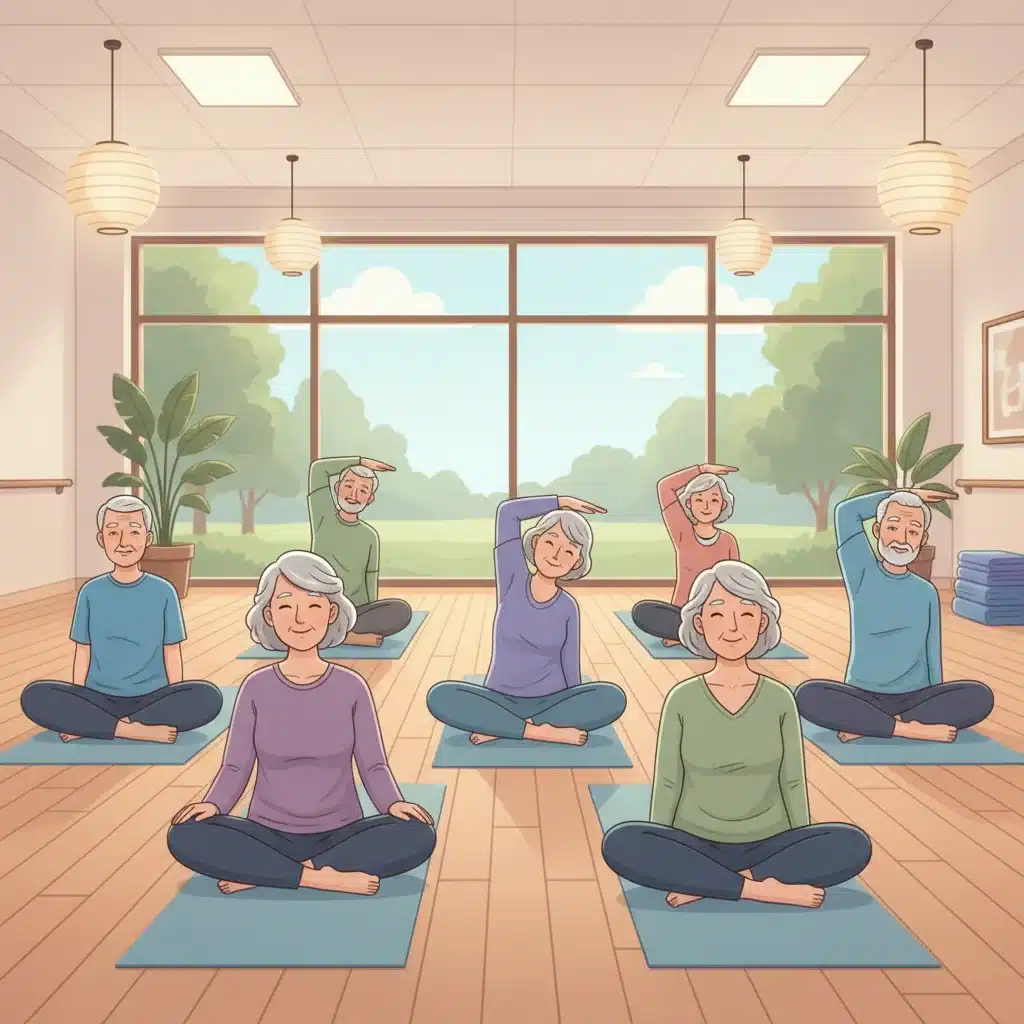
Pose 2: Seated Spinal Twist (Parivrtta Sukhasana)
Target Areas: Spine, shoulders, neck, hips.
Benefits: Improves spinal mobility and flexibility, stretches the shoulders and neck, aids digestion, and can relieve back pain.
How to Perform:
- Remain seated on your chair with your feet flat on the floor, or cross-legged on your mat. Ensure your spine is long.
- Inhale, lengthen your spine.
- Exhale, gently twist your torso to the right. Place your right hand on the back of the chair (or on the floor behind you if seated on the mat) and your left hand on your right knee.
- Keep your shoulders relaxed and avoid forcing the twist. Your gaze can follow your right shoulder or remain forward if that’s more comfortable for your neck.
- Hold for 5-8 breaths, feeling a gentle stretch in your spine and side.
- Inhale to return to center.
- Exhale and repeat the twist to the left side.
- Repeat 2-3 times on each side.
Modifications: If twisting feels too intense, reduce the depth of the twist. Focus on lengthening the spine before twisting.
Pose 3: Supine Knee-to-Chest Pose (Apanasana)
Target Areas: Hips, lower back, hamstrings.
Benefits: Gently stretches the hips and lower back, relieves lower back pain, calms the nervous system, and aids digestion.
How to Perform:
- Lie on your back on your mat with your knees bent and feet flat on the floor, hip-width apart.
- Gently hug your right knee towards your chest, interlacing your fingers around your shin or behind your thigh.
- Keep your left foot flat on the floor, or if comfortable, extend your left leg long on the mat.
- Keep your shoulders relaxed and your lower back pressing gently into the mat.
- Hold for 5-8 deep breaths, feeling a gentle stretch in your hip and lower back.
- Release your right leg and repeat with your left knee.
- For an added stretch, you can hug both knees to your chest, gently rocking side to side.
Modifications: If holding the knee is difficult, use a strap or towel around your shin or thigh to assist. If lying on your back is uncomfortable, you can perform a modified version seated in a chair, hugging one knee at a time.
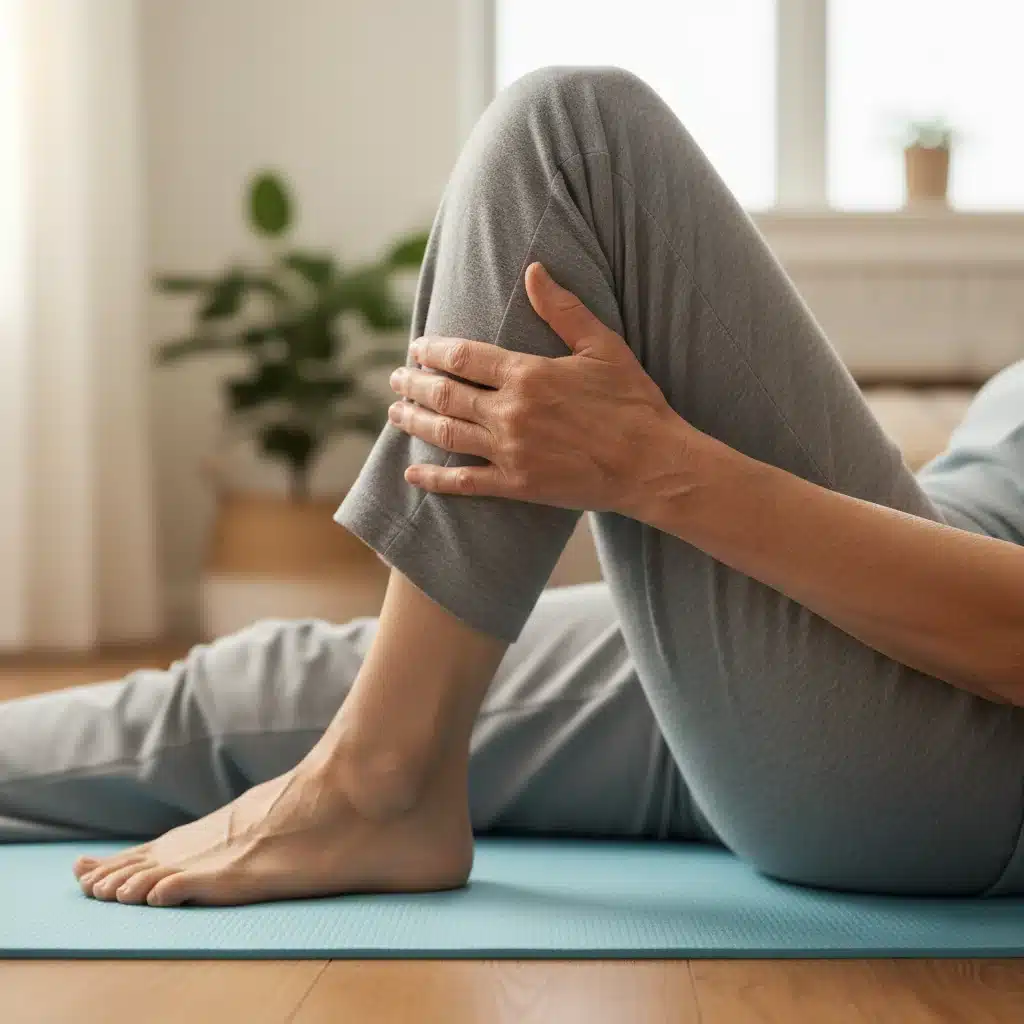
Pose 4: Reclined Figure Four Stretch (Sucirandhrasana)
Target Areas: Hips, glutes, outer thighs.
Benefits: Deeply stretches the outer hips and glutes, improves hip mobility, and can alleviate sciatica pain.
How to Perform:
- Lie on your back with your knees bent and feet flat on the floor, hip-width apart.
- Cross your right ankle over your left knee, creating a figure-four shape with your legs.
- Gently allow your right knee to fall open to the side.
- If you feel a sufficient stretch here, stay. If you’d like a deeper stretch, lift your left foot off the floor.
- Reach your hands through the opening of your legs (between your right and left thigh) and interlace your fingers behind your left thigh.
- Gently draw your left thigh towards your chest, keeping your head and shoulders relaxed on the mat.
- Hold for 8-10 deep breaths, feeling the stretch in your right outer hip and glute.
- Release and repeat on the other side, crossing your left ankle over your right knee.
Modifications: If reaching for your thigh is difficult, use a strap around your left thigh. If the stretch is too intense, keep your left foot on the floor. You can also perform this seated in a chair, crossing one ankle over the opposite knee and gently leaning forward.
Pose 5: Supported Savasana (Corpse Pose) with Bolster/Pillows
Target Areas: Entire body, mind.
Benefits: Promotes deep relaxation, reduces stress, calms the nervous system, integrates the benefits of the practice, and allows the body to fully release tension.
How to Perform:
- Lie on your back on your mat.
- Place a bolster or a few pillows underneath your knees to support your lower back.
- Allow your arms to rest by your sides, palms facing up, slightly away from your body.
- Let your feet fall open naturally.
- Close your eyes and allow your body to feel heavy and relaxed.
- Bring your awareness to your breath, observing its natural rhythm without trying to change it.
- Stay in this pose for 5-10 minutes, allowing yourself to fully surrender to stillness and relaxation.
- To come out, gently wiggle your fingers and toes, gradually bringing movement back into your body. Roll onto your side for a moment before slowly pressing yourself up to a seated position.
Modifications: If lying flat on your back is uncomfortable, you can perform Savasana seated in a recliner chair or with your upper body propped up on pillows.
Integrating Gentle Yoga into Your Daily Life
The beauty of Gentle Yoga Seniors is its adaptability. You don’t need a dedicated studio or hours of free time. These five poses can be practiced individually throughout the day, integrated into a morning routine, or done as a complete sequence in the evening to unwind.
Consistency is paramount. Aim for at least 15-20 minutes of practice, three to five times a week. Even 10 minutes of mindful movement can make a significant difference. Consider setting a specific time each day for your practice, treating it as a non-negotiable appointment with yourself. Journaling about how you feel before and after your sessions can also be a great way to track your progress and stay motivated.
Beyond the physical poses, incorporate the principles of yoga into your daily life:
- Mindful Movement: Pay attention to how your body moves throughout the day. Can you walk with more awareness? Can you lift objects with greater care?
- Deep Breathing: Practice deep, diaphragmatic breathing even when not on your mat. This can reduce stress and improve oxygen flow.
- Listen to Your Body: Respect your body’s signals. If something feels painful, stop. If you need rest, take it.
By making these small adjustments, you’ll find that the benefits of your yoga practice extend far beyond the mat, enhancing your overall vitality and sense of well-being.
Beyond the Poses: The Holistic Benefits of Yoga for Seniors
While our primary focus here is on increasing joint mobility, the advantages of a regular Gentle Yoga Seniors practice are far-reaching and holistic. It’s a comprehensive approach to health that benefits the mind, body, and spirit.
Improved Balance and Fall Prevention
One of the most critical concerns for individuals over 50 is the risk of falls, which can lead to serious injuries and a decline in independence. Yoga, with its emphasis on stability, core strength, and proprioception (the body’s awareness of its position in space), is an excellent tool for improving balance. Many poses, even when modified, challenge your stability in a safe and controlled manner, building the foundational strength and awareness needed to prevent falls.
Stress Reduction and Mental Clarity
The combination of physical movement, controlled breathing (pranayama), and mindfulness in yoga has a profound impact on mental health. Regular practice can:
- Lower Stress Hormones: Yoga has been shown to reduce cortisol levels, the body’s primary stress hormone.
- Improve Mood: It can increase the production of endorphins, natural mood elevators.
- Enhance Focus and Concentration: The meditative aspect of yoga helps to quiet the mind, leading to greater mental clarity and reduced anxiety.
- Promote Better Sleep: By calming the nervous system, yoga can significantly improve sleep quality, which is crucial for overall health and recovery.
Enhanced Bone Health
Weight-bearing exercises are vital for maintaining bone density and preventing osteoporosis. While gentle, many yoga poses involve supporting your own body weight, which can contribute to stronger bones over time. This is especially important for seniors, as bone density naturally declines with age.
Better Posture and Reduced Back Pain
Years of sedentary habits, poor ergonomics, and gravity can take a toll on our posture, often leading to rounded shoulders and chronic back pain. Yoga poses, particularly those that focus on spinal extension and strengthening core muscles, help to realign the spine, strengthen postural muscles, and alleviate persistent back discomfort. The Cat-Cow stretch, for instance, is a fantastic way to gently mobilize the entire spine.
Increased Body Awareness
Yoga encourages you to tune into your body’s sensations, fostering a deeper connection between your mind and physical self. This heightened body awareness can help you identify areas of tension, understand your physical limits, and move more intuitively and safely in your daily life. It’s about becoming an expert on your own body.
Addressing Common Concerns and Dispelling Myths
It’s natural to have questions or reservations when starting a new fitness regimen, especially in later life. Let’s address some common concerns about Gentle Yoga Seniors:
“Am I too old or inflexible for yoga?”
Absolutely not! This is perhaps the biggest myth. Yoga is for everyone, regardless of age, flexibility, or fitness level. Gentle yoga styles are specifically designed to accommodate physical limitations and build strength and flexibility gradually. The poses recommended here are highly adaptable, and the use of props like chairs and blocks makes them accessible to nearly everyone.
“I have arthritis/joint pain. Will yoga make it worse?”
When practiced gently and mindfully, yoga can often alleviate arthritis symptoms and joint pain. The emphasis on slow, controlled movements and listening to your body means you won’t push into pain. In fact, the increased circulation, lubrication of joints, and strengthening of surrounding muscles can significantly reduce discomfort. Always consult your doctor first, and communicate any pain or discomfort with your instructor if you’re in a class setting.
“I’m worried about falling.”
This is a valid concern, and one that gentle yoga addresses directly. Many poses can be performed seated in a chair, or with a chair nearby for support. The focus on balance and building core strength also directly contributes to fall prevention. As your practice progresses, your balance will naturally improve, giving you more confidence in your movements.
“I can’t sit on the floor.”
No problem! As mentioned, many poses can be done from a seated position in a sturdy chair. The key is to find modifications that work for your body, allowing you to reap the benefits without discomfort or strain. Don’t let the traditional image of yoga deter you; modern yoga is incredibly adaptable.
“Is it just stretching, or is it a real workout?”
While gentle yoga certainly involves stretching, it’s much more than that. It builds core strength, improves balance, enhances body awareness, and focuses on breath control – all of which contribute to a comprehensive physical and mental workout. You might be surprised by how much stronger and more energized you feel after a consistent practice.
The Path Forward: Sustaining Your Yoga Journey
Committing to a Gentle Yoga Seniors routine is a powerful step towards a healthier, more mobile future. The 5-pose sequence outlined here is an excellent starting point, a foundation upon which you can build. To truly maximize the benefits and ensure long-term success, consider these additional tips:
Explore Different Gentle Yoga Styles
The world of yoga is vast. While this routine is a great introduction, you might find other gentle styles that resonate with you. Look for:
- Chair Yoga: Specifically designed for those who prefer or need to remain seated.
- Restorative Yoga: Focuses on deep relaxation using props to support the body in passive stretches.
- Hatha Yoga (Gentle Pace): Many Hatha classes are slower-paced and focus on fundamental poses, making them suitable for beginners and seniors.
- Yin Yoga: Involves holding passive stretches for longer periods to target deeper connective tissues.
Experimenting can help you discover what feels best for your body and keeps you engaged.
Join a Local Class or Online Community
While practicing at home is convenient, joining a class (either in-person or online) can offer immense benefits:
- Expert Guidance: A qualified instructor can provide personalized modifications and ensure proper alignment, reducing the risk of injury.
- Motivation and Accountability: Being part of a group can provide the encouragement needed to stick with your practice.
- Social Connection: For in-person classes, it’s a wonderful opportunity to connect with like-minded individuals.
Many senior centers, community centers, and yoga studios offer classes specifically tailored for older adults. Online platforms also provide a wealth of resources, allowing you to practice from the comfort of your home with a virtual instructor.
Listen to Your Body’s Evolving Needs
Your body is not static; it changes daily. Some days you might feel more flexible, other days more stiff. Be patient and compassionate with yourself. Adjust your practice according to how you feel. If a pose doesn’t feel right, modify it or skip it. The goal is to nurture your body, not to push it to its limits.
Celebrate Small Victories
Track your progress. Notice how your joints feel after a few weeks of consistent practice. Can you reach a little further? Is your balance improving? Are you experiencing less morning stiffness? Each small improvement is a victory worth celebrating. These positive reinforcements will fuel your motivation to continue your Gentle Yoga Seniors journey.
Conclusion: Embrace Mobility, Embrace Life
The journey to enhanced joint mobility and overall well-being for Americans over 50 is a rewarding one, and gentle yoga offers a compassionate and effective map. By integrating this 5-pose routine into your life, you are not just performing exercises; you are cultivating a deeper connection with your body, fostering strength, flexibility, and a profound sense of peace.
Our aim for 2026 is a 20% increase in mobility for this demographic, and with consistent practice, this goal is not just achievable, but truly within reach. Imagine the freedom of movement, the reduction in stiffness, and the renewed energy that awaits you. Gentle Yoga Seniors is more than just a physical practice; it’s an invitation to age gracefully, live vibrantly, and embrace every moment with greater ease and joy.
Start today. Your joints, your body, and your mind will thank you.