Unlock 20% Greater Core Strength: 4-Week Yoga Core Plan
Unlock 20% Greater Core Strength: A 4-Week Progressive Movement Plan for Yoga Practitioners
Are you a dedicated yoga practitioner looking to deepen your practice, improve your balance, and unlock more advanced poses? The secret often lies in one crucial area: your core. A strong core is not just about aesthetics; it’s the foundation of all movement, providing stability, power, and protection for your spine. In yoga, a robust core translates to greater ease in transitions, longer holds, and the ability to explore challenging asanas with confidence and control. This comprehensive 4-week progressive movement plan is meticulously designed to help you achieve 20% greater core strength, transforming your yoga journey in the process.
Many yogis understand the importance of core engagement, but often the approach can be scattered or lack a structured progression. This plan changes that. We’ll move beyond simple crunches and delve into a holistic approach that targets the deep intrinsic core muscles, external obliques, rectus abdominis, and the back extensors, ensuring a balanced and functional strength development. By the end of these four weeks, you’ll not only feel significantly stronger but also move with more grace, precision, and a deeper connection to your body.
Why Focus on Yoga Core Strength?
Before we dive into the ‘how,’ let’s solidify the ‘why.’ The term ‘core’ in yoga extends beyond just your abdominal muscles. It encompasses everything from your diaphragm to your pelvic floor, including your deep abdominal muscles (transverse abdominis), obliques, multifidus, and the erector spinae. This intricate network acts as your body’s powerhouse, influencing almost every pose you undertake.
Enhanced Stability and Balance
Think about standing poses like Tree Pose (Vrksasana) or Dancer’s Pose (Natarajasana). Without a strong and engaged core, maintaining balance becomes a wobbly challenge. Your core muscles act as stabilizers, creating a solid center from which your limbs can extend. A 20% increase in Yoga Core Strength means you’ll experience fewer wobbles and greater steadiness, allowing you to hold poses longer and explore their deeper benefits.
Improved Posture and Spinal Health
A weak core often leads to poor posture, back pain, and an increased risk of injury. By strengthening the muscles that support your spine, especially the transverse abdominis and multifidus, you create a natural corset that protects your back and encourages optimal spinal alignment. This is particularly crucial for poses that involve spinal twists and extensions, where proper support prevents strain.
Greater Ease in Transitions and Advanced Asanas
From jumping back to Chaturanga to lifting into Handstand (Adho Mukha Vrksasana), transitions in yoga often demand significant core engagement. With a stronger core, these movements become smoother, more controlled, and less taxing. Arm balances, inversions, and deep twists, which might currently feel out of reach, will become more accessible as your core provides the necessary lift and support.
Deeper Breath and Energy Flow
The core muscles are intrinsically linked to your breath. The diaphragm, a primary muscle of respiration, is part of your core. A strong and flexible core allows for deeper, more efficient breathing (pranayama), which in turn enhances energy flow (prana) throughout your body. This connection between breath and core is fundamental to the yogic philosophy of movement and mindfulness.
Understanding the 4-Week Progressive Framework for Yoga Core Strength
This plan is built on the principle of progressive overload, meaning you’ll gradually increase the intensity, duration, or complexity of your core work over time. Each week builds upon the last, ensuring continuous growth and preventing plateaus. Consistency is key, so aim to incorporate these core sequences into your practice 3-4 times a week, allowing for rest days in between.
Key Principles of the Plan:
- Mindful Engagement: It’s not just about doing the pose; it’s about how you do it. Focus on consciously engaging your core muscles, drawing your navel towards your spine, and lifting through your pelvic floor.
- Breath Awareness: Connect your breath to your core movements. Exhale on exertion, inhale to prepare or release.
- Quality over Quantity: Perform fewer repetitions with perfect form rather than many with sloppy technique.
- Listen to Your Body: While progression is encouraged, never push through pain. Modify as needed and respect your body’s limits.
- Consistency: Regular practice yields the best results. Stick to the schedule as much as possible.
The 4-Week Yoga Core Strength Plan
Each weekly sequence should be performed 3-4 times. You can integrate these into your existing yoga practice (e.g., after warm-up, before savasana) or as standalone core sessions.
Week 1: Foundations and Deep Core Activation
The goal this week is to awaken the deep core muscles, particularly the transverse abdominis and pelvic floor, which are often overlooked. We’ll focus on isometric holds and gentle movements to establish a solid foundation for greater Yoga Core Strength.
Daily Sequence (Repeat 2-3 times):
- Pelvic Tilts (Supine): Lie on your back, knees bent, feet flat. Gently press your lower back into the mat, engaging your lower abs and pelvic floor. Release. Repeat 10-15 times.
- Cat-Cow with Core Engagement: From hands and knees, as you round into Cat, draw your navel strongly towards your spine. As you arch into Cow, maintain a slight engagement to protect your lower back. 8-10 cycles.
- Bird-Dog: From hands and knees, extend opposite arm and leg, keeping your torso stable and hips level. Focus on maintaining a flat back and engaging your core to prevent rocking. Hold for 5-10 seconds per side. 5-8 repetitions per side.
- Dead Bug: Lie on your back, knees bent at 90 degrees over hips, arms extended to the ceiling. Lower opposite arm and leg towards the floor without letting your lower back lift. Keep your core deeply engaged. 8-10 repetitions per side.
- Forearm Plank (Modified): Start on your knees if needed. Focus on a straight line from head to knees/heels, drawing your navel in, and squeezing your glutes. Hold for 30-45 seconds. Rest and repeat 2-3 times.
- Bridge Pose (Setu Bandhasana) with Core Focus: Lift hips, actively drawing inner thighs together and engaging lower abs. Hold for 30 seconds. 2-3 repetitions.
Intention for Week 1: Feel the subtle engagement of your deep core. Prioritize stability over range of motion.
Week 2: Building Endurance and Oblique Strength
This week, we introduce longer holds and movements that challenge your obliques, the muscles responsible for twisting and side bending. We’ll build on the foundation established in Week 1, increasing the duration of holds and adding dynamic elements to enhance Yoga Core Strength.
Daily Sequence (Repeat 2-3 times):
- Forearm Plank (Full): Progress to full plank on toes if comfortable. Hold for 45-60 seconds. Repeat 2-3 times.
- Side Plank (Vasisthasana, Modified/Full): From forearm plank, roll onto one side, stacking hips and feet. You can drop the bottom knee for modification. Lift hips high, engage obliques. Hold for 30-45 seconds per side. Repeat 2-3 times per side.
- Plank with Hip Dips: From forearm plank, gently dip one hip towards the mat, then the other, engaging your obliques. Keep the movement controlled. 10-12 dips per side.
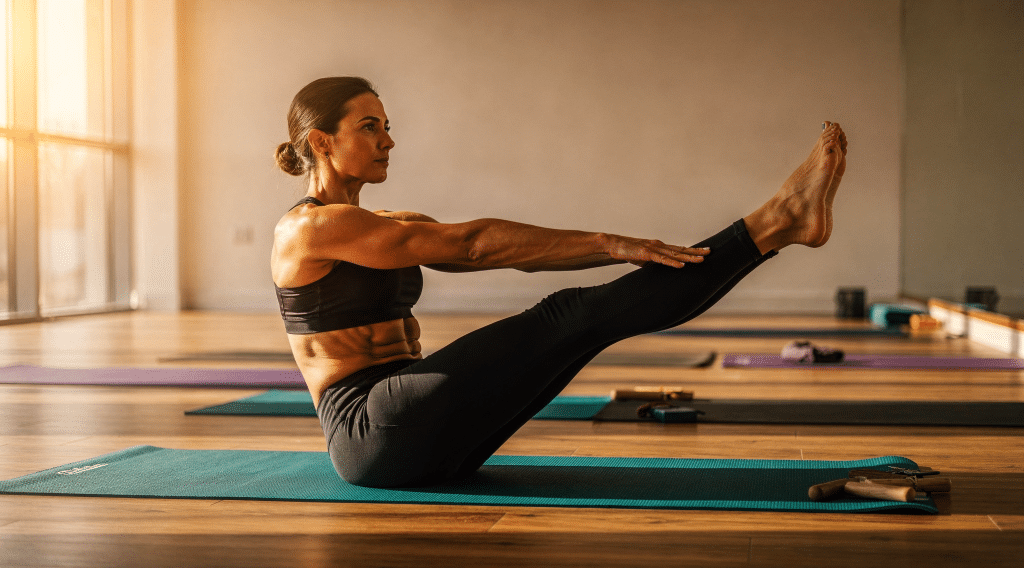
- Boat Pose (Navasana, Modified/Full): Start with knees bent, feet on floor, leaning back slightly. Lift one leg, then the other, or both. Extend arms forward. For full pose, straighten legs. Hold for 30-45 seconds. Repeat 2-3 times.
- Reverse Tabletop (Ardha Purvottanasana): From seated, place hands behind you, fingers forward. Lift hips to form a table shape, engaging glutes and core. Hold for 30 seconds. Repeat 2-3 times.
- Crescent Lunge with Twist (Parivrtta Anjaneyasana Prep): From Crescent Lunge, bring hands to heart center and gently twist towards the front leg. Use your core to initiate the twist, not just your arms. Hold for 30 seconds per side.
Intention for Week 2: Feel the burn! Focus on maintaining stability even as you introduce rotational and lateral challenges. Your Yoga Core Strength is growing!
Week 3: Dynamic Movements and Integrated Strength
This week, we integrate more dynamic movements and flow, challenging your core to stabilize during transitions and more complex actions. We’ll also introduce poses that require significant upper body and core interplay, further enhancing your overall Yoga Core Strength.
Daily Sequence (Repeat 2-3 times):
- Plank Variations:
- Plank with Knee to Elbow: From high plank, draw one knee towards the same-side elbow, then across to the opposite elbow. Alternate. 8-10 repetitions per side.
- Plank Jacks: From high plank, jump feet out wide then back together, like a jumping jack. Keep hips stable. 15-20 repetitions.
- Dolphin Plank to Dolphin Pose Flow: From forearm plank, press hips up and back into Dolphin Pose, then shift forward into forearm plank. Flow smoothly. 8-10 repetitions.
- Low Boat to High Boat Flow: From a seated position, flow between Low Boat (legs and torso hovering just above the mat) and High Boat (Navasana). Use your breath to guide the movement. 8-10 repetitions.
- Revolved Chair Pose (Parivrtta Utkatasana): From Chair Pose, bring hands to heart center and twist, bringing one elbow to the opposite knee. Deepen the twist from your core. Hold for 30 seconds per side.
- Hollow Body Hold (Modified/Full): Lie on your back. Lift head, shoulders, and legs slightly off the mat, pressing lower back down. Arms can be overhead or by your sides. Hold for 30-45 seconds. Repeat 2-3 times.
- Crow Pose Prep (Bakasana Prep): Squat down, place hands shoulder-width apart. Bring knees high onto triceps. Lean forward, lifting one foot, then the other, or both. Focus on core engagement to lift. Hold for 10-20 seconds.
Intention for Week 3: Feel the power of your integrated core. Notice how your core helps you move more fluidly and with greater control in challenging poses.
Week 4: Peak Core Strength and Advanced Integration
This final week is about solidifying your gains and challenging your newfound Yoga Core Strength with more advanced variations and longer holds. You’ll integrate compound movements that demand maximum core engagement throughout your entire practice.
Daily Sequence (Repeat 2-3 times):
- Advanced Plank Sequences:
- Plank with Leg Lift: From high plank, lift one leg a few inches off the mat, keeping hips level. Hold 15-20 seconds per side.
- Side Plank with Leg Lift: From side plank, lift the top leg. Hold 15-20 seconds per side.
- Dragonfly Twist (Parsva Bakasana Prep/Modification): Explore the twist and lift, using your core to support the rotation and potential lift.
- L-Sit Prep (Dandasana to L-Sit): From Staff Pose (Dandasana), press hands into the mat beside hips, engage core, and lift hips and legs slightly off the floor. Even a slight lift counts! Hold for 10-20 seconds.
- Garland Pose (Malasana) with Core Engagement: Deep squat, elbows pressing into inner knees. Focus on lengthening the spine and engaging the lower core to lift the pelvic floor. Hold for 1 minute.
- Wheel Pose (Urdhva Dhanurasana) or Bridge with Core Control: If Wheel is in your practice, focus on lifting from your core and glutes, not just pushing through your arms. If not, deepen your Bridge Pose, actively engaging core and hamstrings.
- Handstand Prep (L-Handstand at Wall): Face a wall, hands shoulder-width from the wall. Walk feet up the wall until your body forms an ‘L’ shape. Engage core fiercely to keep hips stacked over shoulders. Hold for 30-60 seconds.
- Vinyasa Flow with Core Focus: Integrate strong core engagement into every transition – from Downward Dog to Plank, Plank to Chaturanga, Upward Dog to Downward Dog. Feel your core initiating and supporting every movement.
Intention for Week 4: Celebrate your increased Yoga Core Strength! Notice how much easier challenging poses feel and how much more integrated your movements are. You’ve achieved your goal!
Integrating Core Work into Your Regular Yoga Practice
While this plan provides dedicated core sequences, the true power of enhanced Yoga Core Strength comes from integrating it into every aspect of your practice. Here’s how:
- In Standing Poses: Actively draw your navel towards your spine and lift your pelvic floor. This creates a stable base for Virabhadrasana (Warrior Poses), Trikonasana (Triangle Pose), and all balancing poses.
- In Twists: Initiate twists from your core, not just by wrenching your shoulders. Feel the engagement of your obliques as you rotate.
- In Backbends: Engage your lower abs and glutes to lengthen your lower back and protect your spine. This prevents “dumping” into the lower back.
- In Inversions and Arm Balances: Your strong core is the engine that lifts you up and keeps you stable. Without it, these poses are significantly harder and riskier.
- During Transitions: Use your core to float, jump, and move gracefully between poses. This is where your functional strength truly shines.
Beyond the 4 Weeks: Maintaining and Further Developing Your Yoga Core Strength
Achieving 20% greater Yoga Core Strength in four weeks is a fantastic accomplishment, but it’s just the beginning. To maintain and further develop your strength, continue to incorporate core-focused movements into your routine. You can cycle back through the weeks of this plan, introduce new variations, or explore more advanced core-intensive yoga styles like Ashtanga or Power Yoga.
Nutrition and Hydration
Remember that strength building is not just about movement. Proper nutrition provides the fuel for your muscles to grow and recover. Ensure you’re consuming adequate protein, healthy fats, and complex carbohydrates. Stay well-hydrated, as water is essential for muscle function and overall well-being.
Rest and Recovery
Muscles grow stronger during rest. Don’t skip your rest days. Consider incorporating restorative yoga, gentle stretching, or foam rolling to aid recovery and prevent soreness. Adequate sleep is also paramount for physical and mental rejuvenation.
Mind-Body Connection
Yoga is a holistic practice. As your physical core strengthens, notice how your mental and emotional resilience also grows. The discipline and focus required to build Yoga Core Strength often translate into greater mental clarity and emotional stability off the mat.
Conclusion: Your Journey to a Stronger Core and Deeper Practice
This 4-week progressive movement plan is your roadmap to achieving significantly greater Yoga Core Strength. By committing to the structured practice, focusing on mindful engagement, and listening to your body, you’ll unlock a new level of stability, balance, and power in your yoga practice. Embrace the challenge, enjoy the journey, and prepare to feel the profound benefits of a truly strong and integrated core. Your advanced poses await, and your overall well-being will thank you for this transformative experience. Namaste.